

The Benefits Of UV Coating On SPC Flooring: Surface Protection, Durability, And Maintenance
Oct 28, 2026
Leave a message
Flooring surfaces face continuous exposure to foot traffic, dust, spills, cleaning products, and friction from everyday activities. For residential and commercial projects, maintaining an attractive appearance while controlling long-term maintenance requirements is an important part of product selection. Surface treatment plays a significant role in how a finished floor responds to these conditions.
Ultraviolet (UV) coating is widely used in resilient flooring production to improve surface protection and achieve specific decorative finishes. In SPC Flooring, its contribution extends beyond appearance, influencing resistance to everyday stains, surface wear, and routine cleaning demands. Understanding the coating's functions, limitations, and production requirements helps buyers evaluate flooring products more accurately and select finishes suited to their intended applications.
What Is UV Coating and How Does It Work?
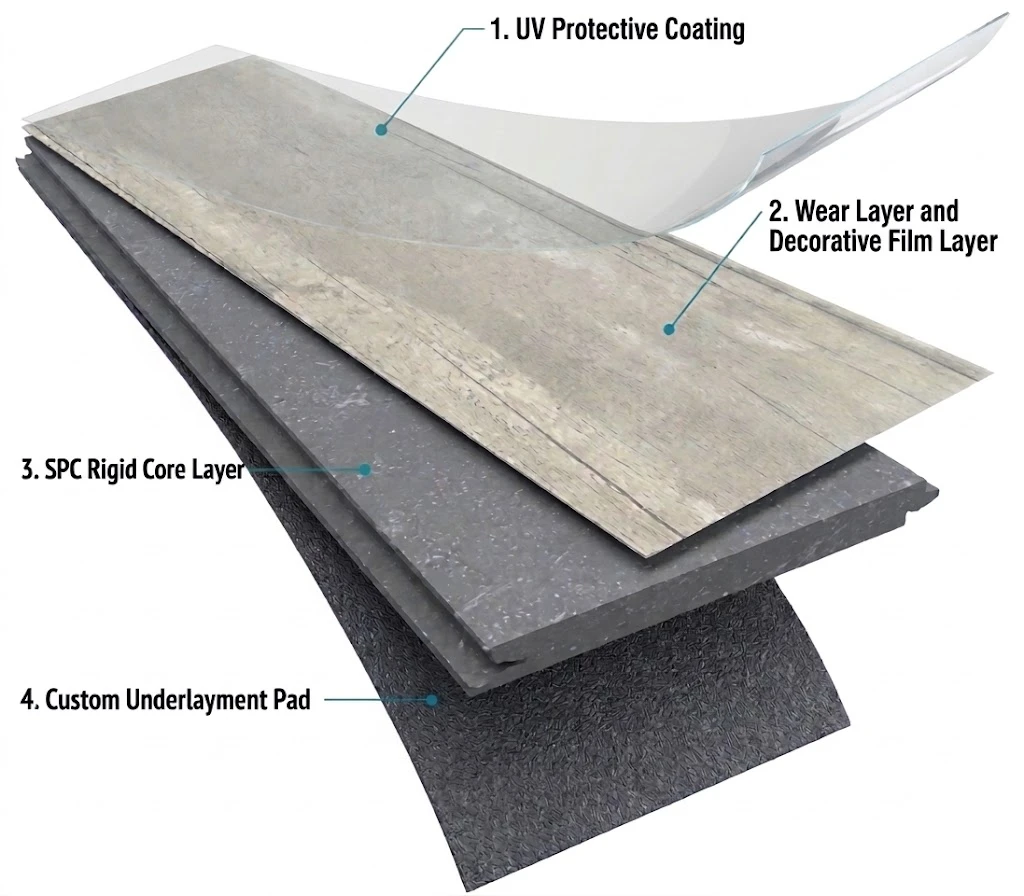
UV coating is a surface treatment that uses ultraviolet radiation to cure specially formulated liquid materials into a solid film. The formulation typically contains components that react under UV exposure, forming a cross-linked coating. Once properly cured, this film provides a protective surface with properties determined by its chemistry, application conditions, and final structure.
In SPC Flooring production, UV coating is generally applied over the decorative surface and transparent wear layer. The coating may include a primer and a topcoat, depending on the manufacturer's process and performance requirements. The primer can help establish adhesion between layers, while the topcoat provides the final surface characteristics, including gloss level and resistance to everyday contamination. Not every product uses an identical coating system, so the actual construction should be confirmed through product specifications.
Key Benefits of UV Coating
Improved Surface Protection
A properly formulated and cured UV coating can help a floor withstand minor scratches, scuffs, and friction associated with normal use. Certain formulations incorporate functional additives or hard particles to improve specific surface properties. These characteristics are particularly relevant in spaces where chairs move frequently, occupants wear outdoor footwear, or furniture is repositioned during daily activities.
For SPC Flooring, surface protection should not be confused with complete scratch prevention. Sharp objects, abrasive particles, heavy loads, and dragged furniture can still damage the finish. Overall wear performance also depends on the transparent wear layer, coating formulation, manufacturing quality, and conditions of use. Buyers should therefore assess the complete flooring construction rather than treating the coating as the sole indicator of durability.
Better Stain Resistance and Easier Cleaning
The surface film can help reduce the attachment of common household dirt and certain spills, making routine cleaning more manageable. A suitable finish allows dust and many everyday residues to be removed without aggressive scrubbing, which can reduce unnecessary abrasion during maintenance. This benefit is useful in offices, hospitality spaces, residential interiors, and other environments where regular cleaning is required.
The level of stain resistance depends on the coating chemistry and the substances involved. Strong dyes, chemicals, oils, or prolonged exposure to certain contaminants may still leave marks or damage the finish. Prompt spill removal and cleaning products approved for the specific flooring system remain important. A coating should support a practical maintenance routine, not replace it.
More Control Over Appearance and Surface Finish
UV coating provides manufacturers with options for adjusting surface gloss and visual character. Depending on the formulation and finishing process, products can achieve matte, satin, or higher-gloss appearances. These options allow buyers to coordinate flooring with different interior styles, from understated residential spaces to contemporary commercial environments.
Consistent application is equally important. Uneven coating distribution, variations in curing, or differences between production batches can create visible gloss discrepancies under directional lighting. Such variations may be especially noticeable across large open areas where multiple planks sit within the same field of view. Sample approval should therefore consider not only color and pattern but also surface reflection and finish consistency.
UV Coating vs. Wear Layer: Understanding the Difference
Although these components work together, they perform different functions within the flooring surface. The transparent wear layer protects the decorative design against abrasion and everyday wear, while the outer UV coating primarily modifies and protects the exposed surface. Their performance characteristics overlap in some areas, but one cannot automatically compensate for deficiencies in the other.
| Comparison Factor | UV Coating | Transparent Wear Layer |
|---|---|---|
| Structural Position | Outermost surface treatment | Beneath the surface coating |
| Main Purpose | Surface protection and finish control | Protection of the decorative layer against wear |
| Design Influence | Gloss, surface feel, and finish characteristics | Transparency and preservation of the printed design |
| Evaluation | Surface resistance, adhesion, stain response, and finish consistency | Thickness, abrasion performance, and applicable wear tests |
For procurement decisions, these differences matter because a visually attractive coating does not necessarily indicate a high abrasion rating. Likewise, a thicker wear layer alone does not establish that the finished surface will provide the desired stain resistance or gloss consistency. Reviewing both components and their relevant test results gives buyers a more complete basis for comparing SPC Flooring products.
What Factors Affect UV Coating Performance?
Formulation and curing conditions are central to the quality of the finished film. Resin selection, additives, coating viscosity, application uniformity, and UV energy all influence the curing process and resulting surface characteristics. Insufficient curing may affect hardness or adhesion, while an unsuitable formulation can create an imbalance between surface resistance and flexibility. Appropriate process settings must be established for the specific coating system rather than copied indiscriminately from another production line.
Manufacturing control also affects consistency. Surface preparation, primer application, coating weight, equipment condition, and curing verification all require attention. Common defects include gloss streaks, uneven texture, poor adhesion, and differences between batches. These issues may originate from different causes, so inspection and process records are useful for identifying deviations and determining corrective measures. Stable production conditions help manufacturers reproduce the approved finish across larger orders.
How to Maintain UV-Coated Flooring
A practical maintenance routine can be organized around four measures:
- Remove abrasive particles regularly. Sand, grit, and other hard particles can cause friction when repeatedly walked across or dragged along the surface. Sweep or vacuum with an appropriate floor attachment to prevent accumulation.
- Protect high-use areas. Furniture pads and protective mats can reduce localized friction caused by moving chairs, furniture, and equipment.
- Use suitable cleaning products. Follow the flooring manufacturer's recommendations for cleaning products, dilution, and application. Avoid abrasive scouring materials, unapproved solvents, and harsh chemicals that may affect the coating.
- Clean spills promptly. Remove spills before residues accumulate. Treat stubborn marks with an approved cleaning method rather than aggressive scrubbing.
Maintenance procedures should reflect the actual surface finish and environmental conditions of the installation. Even a well-finished floor requires appropriate care to maintain its appearance over time.
What Should Buyers Check Before Purchasing?
Review Technical Documentation: Assess test results for scratch resistance, stain resistance, coating adhesion, gloss measurements, and abrasion performance. Check the test methods and acceptance criteria, as results from different methods may not be directly comparable.
Inspect Physical Samples: Examine color, texture, gloss, and surface uniformity under different lighting conditions. Confirm that approved samples represent the intended production finish.
Verify Batch Consistency: Check how the manufacturer monitors coating quality and surface appearance across production batches. Review maintenance instructions and confirm that performance claims are supported by product-specific test reports.
Establish Acceptance Criteria: Define requirements for appearance, surface defects, packaging, and inspection records before bulk production begins. For custom finishes, agree on these criteria in advance to reduce discrepancies between approved samples and delivered products.
Awood's Approach to SPC Flooring Product Development and Selection
Awood Design Flooring develops flooring products for different interior styles and project requirements, including engineered wood, parquetry, and other resilient flooring options. Its product development approach includes decorative choices and surface finishes intended to meet varied design preferences. For buyers comparing products, discussing the intended application, appearance requirements, and maintenance expectations early in the selection process can help narrow the available configurations.
When evaluating a flooring solution, buyers should consider the complete product rather than focusing on one surface treatment in isolation. Coating characteristics, wear-layer construction, decorative design, production consistency, and supporting documentation all contribute to the suitability of the finished floor. For SPC Flooring projects, matching these factors to the project specification provides a more useful basis for product selection than relying on broad performance claims alone.